
Google Ads Strategy — Business vs Cost
This article focuses on how to think about ad optimization. I've covered optimization before, centered on finding improvable metrics through data analysis. This one approaches strategy from the business angle. Two schools:
One: the business angle — walk the business process. Two: the cost-first angle.
Most optimization briefs on the market chase lower CPC. I can't call that wrong, but it's not how I'd optimize. If you've read the brief history of Google advertising, you'll see why.
Approach 1 — business process
Start from the user's journey: map every touchpoint from seeing the ad → visiting → on-site → purchase, and optimize each with precision. Draw improvement ideas from competitors' journeys and your own experience as a user.

User experience journey
Remember, every optimization must land as a concrete action: landing page — URL choice, feed optimization; creative — keyword fit, CTR, CVR; audience — device, country, time, network, context; budget — adjusted against profit margin and actual ad ROI.
Approach 2 — cost first
This school starts from cost, steering campaign settings by CPA, ROI and similar metrics. It's narrower — but when judging whether a test campaign is working, cost-first is the right lens, especially for conversion-goal campaigns. I prioritize process-first, particularly for small and mid-size businesses whose core is business process and profit model. Yet most people's first instinct is to copy the JDs of large, mature companies — the market's fashionable "cost-first" thinking. Not wrong; just limited.
From 0 to 1, the most important thing is finding who your users are
— and using limited money to feed as much conversion data as possible to the pixel or Google's ML to get through the learning phase. At this stage, breaking even is acceptable.
From 1 to 100, cost awareness matters, but exhausting user detail matters more.
Sharpen the persona: precise age brackets, concrete preferences, creative types. Run at compressed margins for faster growth and insight.
From 100 to ∞, focus on cost.
Marginal growth is worth less now; the game is balance — growth rate vs cost control — holding ROI steady, managing spend ratio, lifting net margin. That's why optimizer JDs at big, mature companies read cost-first: they're simply past the growth phase. Apply their requirements to your own young business and your growth will lag theirs, guaranteed. The more awkward truth: small businesses have limited capital, and large-scale spending in today's cost-cutting climate is unrealistic. Where does ad money come from? Profit, or investors. Early on there's no profit, and in 2024 investors have lost their nerve — so I understand why so many companies demand big-company discipline from day one: control costs AND grow… it's hard for everyone. Either way, data is the foundation, and test logic must follow the ad technology itself to serve the goal.
Account architecture
All architecture follows the platform's own characteristics; within the framework, minimizing internal competition is the main design principle.
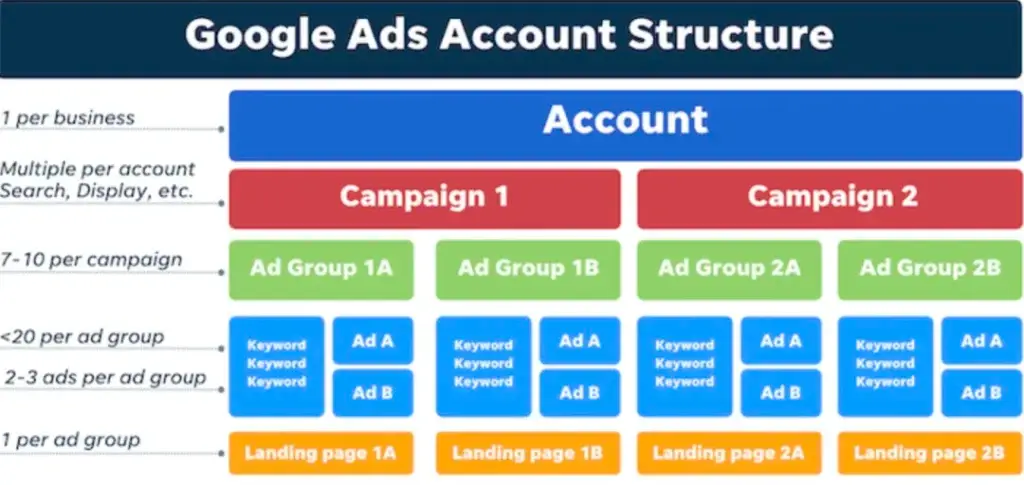
Ad architecture
The diagram lays out the basic structure, but note: layers compete with each other. A chaotic account structure wastes resources and can bid your own CPC up against yourself — which is, admittedly, one very silly way to build a moat… There is no absolutely correct account structure; build yours from your goals and platform knowledge. As a rule, avoid competing with yourself:
- Ad-group level: groups within one campaign compete. (They share a budget, so the better performer wins impressions and the weaker one may get none.) When a user searches or browses, Google picks the most competitive ad given your campaign and group settings. So be clear about intent: for creative or keyword A/B tests, same-campaign competition is useful; for scaling tests, put the new group in a different campaign.
- Campaign level: campaigns within one account compete. Identical settings compete; clearly differentiated settings don't. That requires the operator to think positioning and architecture through. Competition run deliberately to validate something — say re-running a campaign whose algorithm seems broken — is acceptable short-term; shut it down when the test ends.
- Account level: accounts compete on the platform too. A company may hold multiple accounts for attribution tooling, vendor tests, agency rebates or disaster recovery. Competition here follows ad history. A good pattern: one stable main account, with test-specific accounts under separate manager accounts — minimizing cross-account competition.
A measured dose of competition improves structure and performance, but long-term self-competition across layers hurts development.