
Shopify Editions Winter 2026: 8 Updates That Matter to Global Sellers

Use this map to keep the article focused on news-analysis and the decisions most relevant to Shopify merchants operating across countries or evaluating AI, international checkout, payment, and fulfillment workflows.
The short version: Shopify Editions Winter 2026 is worth reviewing, but most merchants should not try to activate 150-plus updates. The changes with the clearest international-commerce impact are a more capable Sidekick, product discovery in AI shopping channels, native Rollouts, and more granular market checkout, profit, payment, and shipping tools. Many other launches are US-only, Plus-only, POS Pro-only, early access, or research previews.
One date needs correcting before anything else. Shopify calls this the Winter ’26 Edition, or the Renaissance Edition, but it was released on December 10, 2025, as the official Shopify Changelog confirms. By July 24, 2026, Spring ’26 is the newer Edition. This article is therefore a current-evidence review of Winter ’26, not a claim that it is Shopify’s latest feature set.
This review is based on Shopify’s Editions page, Changelog, and current Help Center documentation. It is not presented as hands-on testing of every feature. Plans, regions, eligibility, and early-access status can change, so verify the relevant page and your own admin before implementation.
The cover is an original AI-assisted editorial image created by Haiwaibiji with OpenAI image generation. It illustrates a cross-border team evaluating platform updates; it is not a Shopify interface, partnership endorsement, or measured result.
Official Shopify Winter ’26 video
Official video: Shopify Editions Winter ’26 Trailer, published by Shopify. It is useful for the release theme, but it does not replace feature documentation or eligibility checks.
The eight updates in one decision table
| Update | Practical value for global commerce | Important limitation | First action |
|---|---|---|---|
| Sidekick Pulse and multi-step work | Proactive suggestions, reports, task lists, and selected admin actions | Review, save, install, or approval steps remain; some capabilities have plan or usage limits | Begin with read-only analysis before write actions |
| Agentic Storefronts | Potential product discovery across ChatGPT, Google, Copilot, Meta, and other AI channels | Eligibility and checkout flow vary by channel; no guarantee of recommendation, ranking, or sales | Improve product attributes, brand knowledge, policies, and imagery |
| Rollouts | Schedule, stage, or experiment with theme and checkout changes | Launches start on Basic; experiments require Grow or above; headless checkout is unsupported | Schedule one low-risk campaign change |
| Market-specific checkout and accounts | Adapt messages, policies, and experiences by country or B2B buyer | Advanced or Plus only | Customize only markets with a real operational difference |
| Profit by market | Connect product costs, shipping, duties, and import tax to market decisions | Missing cost-per-item data makes the report incomplete | Enter costs before judging market expansion |
| Payments and Shop Pay expansion | More local-payment and Global-e scenarios | Merchant entity, Shopify Payments, Global-e, and country eligibility apply | Validate one target country at a time |
| Cross-border labels and packaging | DDP/DDU labels, more carriers, and variant packages can reduce rate errors | Several features are limited to named countries | Test checkout and labels with real SKUs and addresses |
| Catalog, Collective, and B2B | 2,048 variants, Unlisted status, broader Collective reach, and wholesale workflows | Theme, app, country, Plus, and POS conditions vary | Adopt only where catalog or wholesale complexity justifies it |
1. Sidekick is moving beyond question answering
Winter ’26 put Sidekick at the center of the release. Shopify highlighted Pulse suggestions, custom app generation, Flow automation, ShopifyQL reports, segments, theme work, and image editing. The current Sidekick Help Center is more useful than the launch headline: it documents reports and visualizations, form completion, order editing, task lists, app discovery, and work with selected third-party apps.
That still does not mean “autonomous store management.” Orders, discounts, shipping, and money-related actions can require preview or approval. Theme changes must be saved manually. Reports are only as reliable as the cost, tagging, and catalog data available to them.
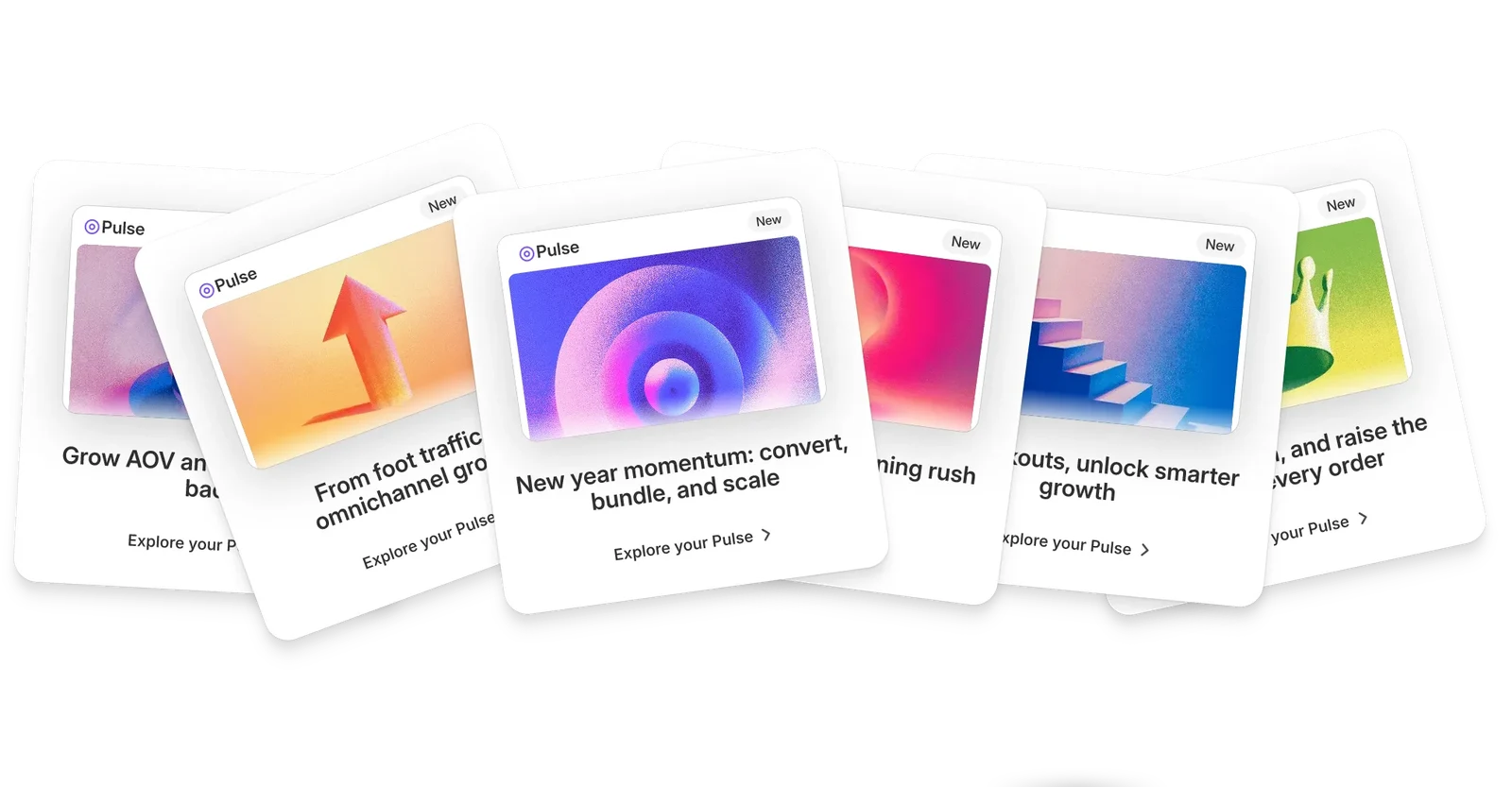
Image source: Shopify Editions Winter ’26 Sidekick Pulse asset, reviewed July 24, 2026. It identifies the product’s proactive-guidance positioning; interface and availability can change. Copyright Shopify.
A sensible starting point for a small team
I would start with three low-risk jobs:
- Generate read-only reports by product, market, or channel.
- Turn inventory, return, or checkout patterns into a reviewable task list.
- Draft a Flow automation, then inspect every trigger, condition, and action before activation.
Observe whether Sidekick reads the data correctly before allowing it to edit orders, install apps, or create internal tools. Faster execution of a bad assumption is still a bad outcome.
2. Agentic Storefronts is not “switch it on and get AI orders”
The current Shopify Agentic Storefronts documentation says eligible stores can make products discoverable through AI channels such as ChatGPT, Google AI Mode and Gemini, Microsoft Copilot, and Meta. Merchants can manage channels in the admin, retain the customer relationship and post-purchase experience, and see channel or referrer attribution.
Two limitations matter.
- Google AI Mode and Gemini remain early access and are not available to every store.
- The purchase path differs by channel. As of this review, ChatGPT primarily acts as a discovery and referral experience that hands the customer to the merchant’s checkout, while selected other channels can use a Shopify-powered direct checkout when enabled.
The immediate job is not to predict automatic AI sales. It is to improve product titles, categories, attributes, images, shipping, returns, duties, and brand knowledge. AI channels do not repair vague catalog data; they distribute it.
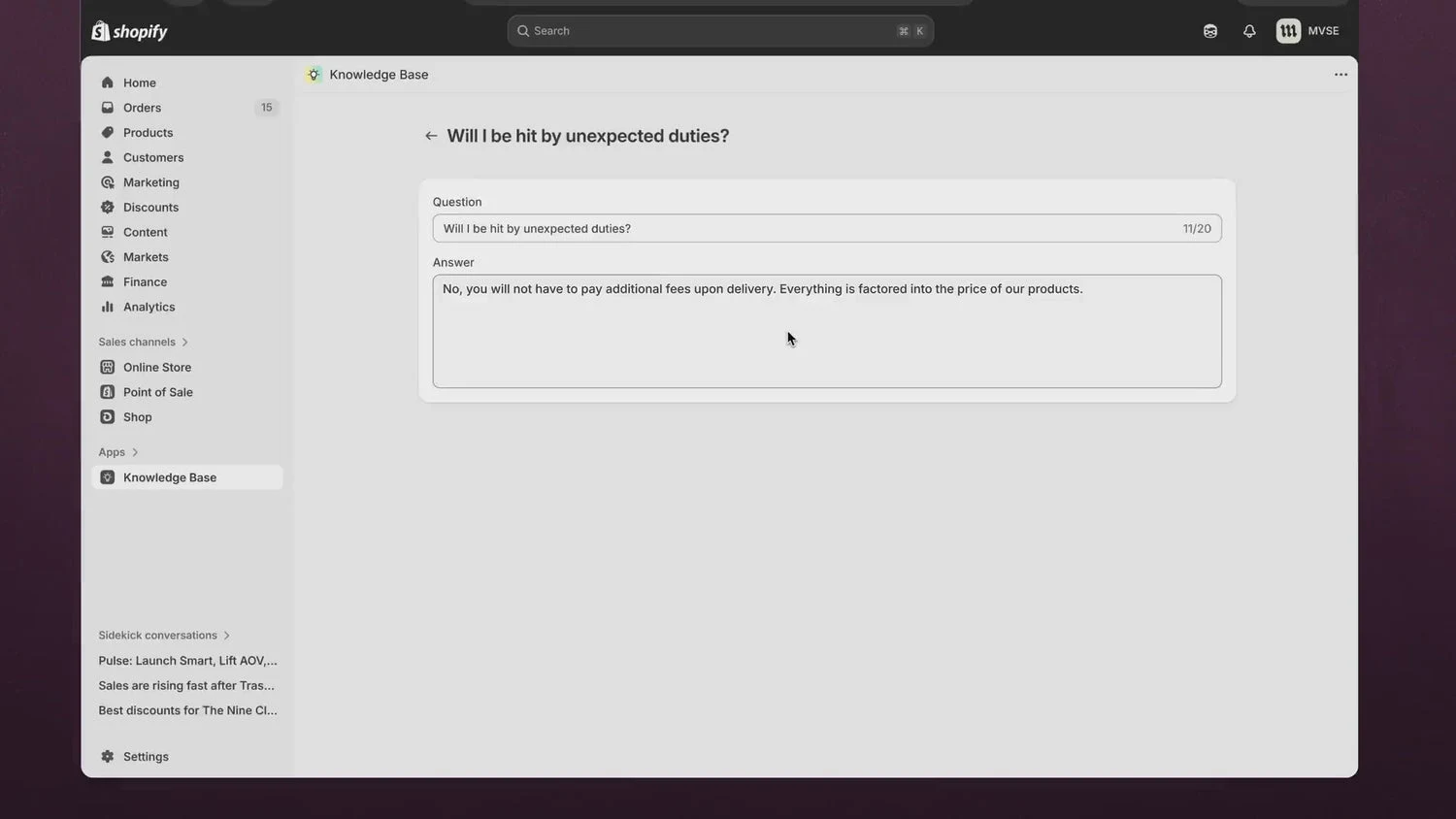
Image source: Shopify Editions Winter ’26 Agentic Storefronts preview, reviewed July 24, 2026. The frame shows a merchant maintaining a duties answer in Knowledge Base, illustrating the need for structured brand information. Copyright Shopify.
Merchants already selling through Google should also audit titles, GTINs, prices, shipping data, and landing-page consistency with the Shopify to Google Merchant Center guide. Agentic discovery is not a shortcut around feed quality.
3. Rollouts: native scheduling and experimentation in Shopify
Shopify’s Rollouts documentation covers scheduled theme, checkout, and account configurations, gradual launches, and control-versus-treatment experiments. Launch Rollouts are available from Basic, while experiments require Grow or above. Headless and custom storefront checkouts are not supported.
For many international merchants, the first value is operational safety rather than sophisticated growth science:
- Prepare a holiday or regional promotion in advance.
- Expose a change to only part of eligible traffic.
- Revert automatically at the end of a campaign.
- Compare control and treatment data instead of declaring a conversion win from intuition.
If plan selection is still open, use the Shopify plan guide before upgrading. A store needs enough traffic, a clear hypothesis, and interpretable metrics before an experiment tier creates value.
4. Market-specific checkout and profit are closer to real operations
Winter ’26 introduced country-, market-, and B2B-specific checkout and customer-account adaptations. A merchant could show a market-specific shipping delay, return option, message, or policy. The current market-specific checkout documentation is explicit: this capability requires Advanced or Plus and at least one configured market.
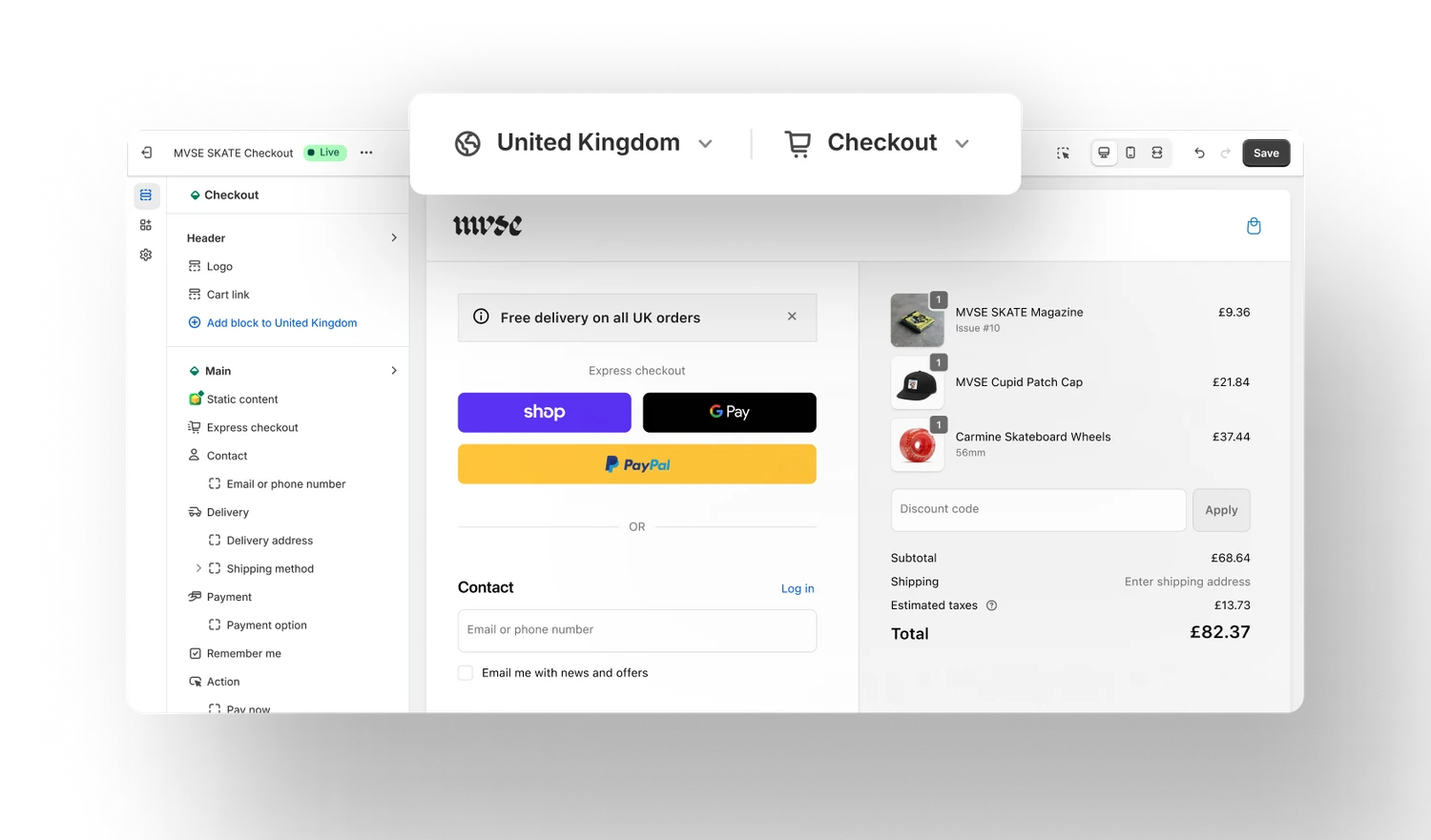
Image source: Shopify Editions Winter ’26 checkout asset, reviewed July 24, 2026. It identifies the relationship between a United Kingdom market and a Checkout configuration. Interface, payments, and plan requirements can change. Copyright Shopify.
The Shopify profit reports documentation also explains market-level reporting for product charges, shipping charges, duties, import taxes, product cost, and costs paid by the store. The plain prerequisite is easy to miss: the product or variant needs cost-per-item data at the time of sale.
Without cost data, a polished chart is still half an account. The dependable order is to add costs, calculate contribution margin, run a real order, and only then expand. The Shopify Markets implementation guide covers that workflow.
5. Payment expansion remains country-specific
Winter ’26 listed Shop Pay with Global-e, Shop Pay Installments in the UK, and additional cross-border methods in France, including Bancontact, iDEAL, Twint, Blik, Przelewy24, MobilePay, and EPS. Klarna also expanded to more European countries.
That is not “global payments solved.” Merchant entity, Shopify Payments, Global-e, target country, currency, and compliance eligibility still decide what is available. Before enabling local currencies, distinguish display, processing, and settlement currency, then run a test order using the Shopify local-currency guide.
6. DDP/DDU and packaging directly affect rate estimates and fulfillment
Less glamorous shipping changes can have a direct operational effect:
- Canadian merchants can buy DHL Express DDP/DDU and Canada Post DDP labels in the admin.
- US merchants can buy DHL eCommerce DDU labels.
- Royal Mail in the UK, Australia Post in Australia, and DHL Express in Canada gained direct label support.
- A default package can be assigned to a variant to improve checkout rates and label purchase for single-item orders.
The coverage is narrow, and a variant package primarily helps single-item orders. Multi-item orders still need store-default packaging and packing-logic checks. Test high-dimensional-weight, high-return, and remote-zone orders first, then use the Shopify Markets shipping guide for troubleshooting.
7. 2,048 variants, Unlisted status, and discount eligibility improve catalog control
A product can now support up to 2,048 variants, which matters for catalogs with extensive size, color, material, or bundle combinations. That does not prove that every older theme, app, ERP, feed, and sales channel is compatible. Use one test product to inspect the selector, URL, inventory synchronization, feed, and order data.
Unlisted status suits wholesale links, previews, or private campaigns: the product is hidden from normal search and collections but remains accessible to anyone with the URL. It is not password protection or access control.
Market-, segment-, and B2B-company-location discount eligibility can reduce duplicate discounts. Currency rounding, combination rules, and local promotion requirements still need testing. Better catalog capacity increases the need for dependable master data; it does not excuse temporary tags and manual exceptions.
8. Collective and B2B expansion does not mean unrestricted global access
Winter ’26 said Shopify Collective added 35 countries and introduced supplier discovery, public price-list imports, payment requests by fulfillment, B2B store credit, and more ERP connections. These are relevant to brands testing distribution, wholesale, or lower-inventory expansion.
But “available globally” is not literal worldwide availability. The current Shopify Collective Help Center still requires country, currency, payment, and store-eligibility checks. Dynamic payment terms, deposits, and order-review rules can also require Plus and a third-party or custom app.
Shopify Product Network, another prominent launch, was US-only. For merchants elsewhere, it was a directional signal rather than an immediate growth channel.
Which launches should wait?
SimGym
SimGym uses AI shoppers to simulate storefront behavior, but it remains an AI Research Preview. It can surface questions; it cannot replace real-user experiments or provide a guaranteed conversion forecast.
Sidekick-generated custom apps
These can help with internal admin tools, but they are not complete storefront, checkout, or external SaaS applications. Start with one reversible internal task with no financial risk.
US-only growth and finance tools
Product Network, selected Shop Campaigns, Balance, Credit, Capital, and shipping launches have little immediate value to a merchant that does not meet the regional requirements. Do not copy US release-page availability into a global operating plan.
A practical 30-day adoption order
Week 1: confirm eligibility, change nothing major
- Open Sales channels > Agentic, confirm store eligibility, and read the supplemental terms.
- Check the plan requirements for Rollouts experiments, market checkout, and B2B.
- Record region and permission requirements for each feature.
Week 2: repair the data
- Complete titles, attributes, costs, weights, packages, and return information for priority SKUs.
- Align currency, language, shipping, and policy answers by target market.
- Reconcile Google feed data with the landing page.
Week 3: run two low-risk tests
- Ask Sidekick for a read-only report or task list, not a money or order change.
- Schedule one small theme change in Rollouts and define the rollback condition first.
Week 4: let business evidence decide
Track task time, errors, human review, market profit, and checkout completion. Stop if the workflow creates more rework. Expand only when it reduces manual effort or improves decision quality. Include software and labor in the calculation.
My conclusion
Compared with the site’s historical Shopify Editions 2024 notes, Winter ’26 is more relevant to international commerce work. AI moves from copy generation toward admin tasks, AI shopping demands better product knowledge, and market tools connect checkout, profit, and shipping decisions more closely.
The main risk is equally clear: the Editions page describes direction; the Help Center, admin eligibility, plan, and country determine reality. Product data, costs, shipping, policies, and experimental discipline should come before the shiny features. Without that foundation, Sidekick, Agentic Storefronts, and Rollouts simply move confusion faster.
FAQ
- When was Shopify Editions Winter 2026 released?
- Shopify calls it the Winter ’26 Edition, but it was released on December 10, 2025. By July 2026, Spring ’26 is the newer Edition, so this page treats Winter ’26 as a dated release review rather than the latest feature list.
- Can every Shopify store use every Winter ’26 feature?
- No. Availability can depend on Basic, Grow, Advanced, Plus, POS Pro, country, early access, app eligibility, and storefront type. Recheck the relevant help page and your own admin before implementation.
- Which Winter ’26 updates should an international seller test first?
- Start with product and brand data for Agentic Storefronts, use Sidekick for reviewable admin work, test a low-risk Rollout, and add product costs before using market-level profit reports. Do not enable everything at once.